When I started building the Illinois Valley Wine Trail earlier this year, I thought I was researching a fairly specific question:
How do you build a successful wine trail with only four wineries?
That question sent me down quite a rabbit hole.
Over the past several months, I’ve researched wine trails across the country and spoken directly with people who have spent years, and sometimes decades, doing this work.
I’ve talked with leaders connected to wine trails in Oregon, Missouri, New York and Pennsylvania. I’ve studied tiny wine trails and large ones. I’ve looked at organizations run by wineries, organizations with professional Executive Directors, wine trails managed through Chambers of Commerce, and destination organizations that contract professional agencies to perform their work.
And somewhere along the way, my original question changed.
I stopped asking only:
How do we build a successful wine trail?
And started asking:
Can a small rural wine trail become a catalyst for building a stronger rural destination?
That question has changed the way I’m looking at the Illinois Valley Wine Trail.
Four Wineries Isn’t Necessarily a Limitation
The Illinois Valley has four wineries:
Augustino Estate & Vineyard, Bridgeview Vineyards & Winery, Deer Creek Vineyards and Foris Vineyards.
We’re probably never going to have 28 wineries like the Seneca Lake Wine Trail in New York.
And that’s okay.
One of the most important things I’ve learned through this research is that we don’t necessarily need to measure our potential by how many wineries we have.
Our growth can come from something else entirely.
It can come from encouraging people to visit more often.
To stay overnight.
To have dinner.
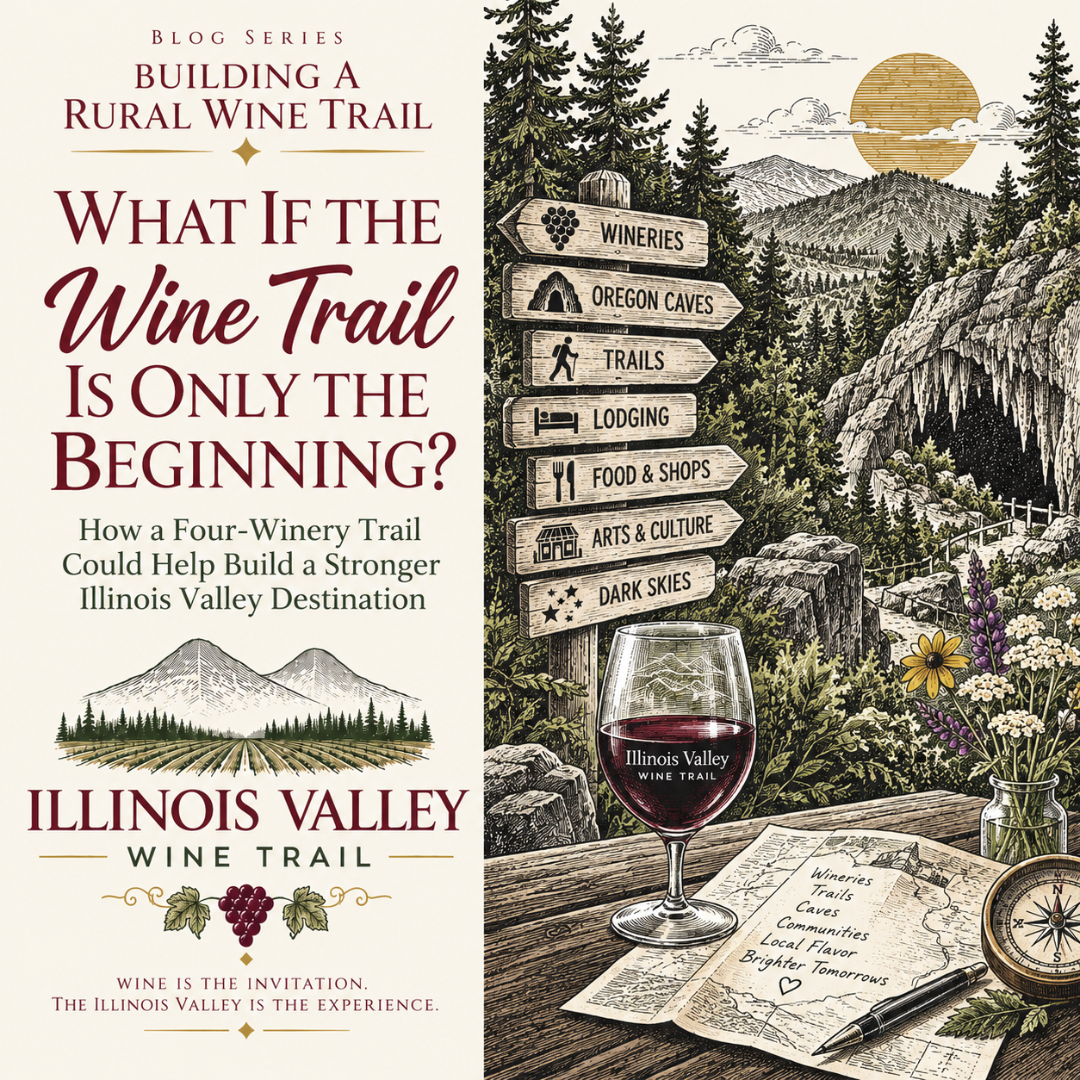
To explore Oregon Caves.
To discover a trail.
To shop downtown.
To attend an event.
To stay for breakfast the next morning.
To visit another business they didn’t know existed.
And to come back in another season.
Suddenly, four wineries aren’t the entire tourism product.
They’re four really good reasons to start exploring.
There Isn’t One Right Way to Build a Wine Trail
Another major lesson from this research is that successful wine trails don’t all look alike.
Some are primarily winery associations.
Some have paid Executive Directors.
Some contract professional management.
Some work closely with Chambers of Commerce or destination organizations.
Some depend heavily on membership dues, while others generate substantial revenue through events.
Some ask participating wineries to contribute wine, food, staff time or other resources in addition to financial support.
And some maintain winery membership while creating separate ways for restaurants, lodging properties, transportation providers, attractions and other tourism businesses to participate.
That’s important for the Illinois Valley because we don’t need to force ourselves into someone else’s organizational mold.
We need to understand the options well enough to build the structure that makes sense here.
One of the Biggest Lessons: Governance Is Not Management
This may sound terribly exciting only to someone who enjoys organizational research as much as I do, but stay with me.
One of the clearest patterns I’ve found is that the people who govern an organization do not necessarily have to be the people doing its daily work.
A winery board can establish priorities, approve budgets and make policy decisions while a professional Executive Director carries out the work.
Or the organization can contract with a Chamber.
Or an agency.
Or another professional provider.
That distinction matters because rural organizations often begin with enormous amounts of volunteer labor.
That can get something started.
It isn’t necessarily a sustainable operating model.
If a wine trail needs website management, event production, marketing, bookkeeping, partnerships, visitor communications, social media, ticketing and administration, those functions still have value even when someone happens to be doing them for little or no compensation.
One of our jobs during the Illinois Valley Wine Trail’s three-year incubation period is to figure out what the organization actually requires to operate sustainably after the startup stage.
Then Hermann Changed the Question Again
My conversation with the Hermann Wine Trail in Missouri was especially interesting.
Hermann has six wineries today, so its Wine Trail isn’t enormous.
But Hermann itself already had something the Illinois Valley doesn’t currently have at the same scale:
a mature visitor economy and substantial lodging infrastructure.
The Wine Trail could create events that brought hundreds of people into a community already equipped to accommodate them.
That made me realize that Illinois Valley is starting from a different position.
We’re not simply organizing wineries inside a mature tourism destination.
We may be helping build the destination infrastructure around them.
And that sent the research in an entirely new direction.
What Are Visitors Doing After They Get Here?
We already have people coming to the Illinois Valley.
Oregon Caves National Monument and Preserve alone gives travelers a major reason to come through our community.
We also have forests, rivers, trails, wineries, agriculture, artists, events, small businesses, Dark Sky opportunities and some wonderfully unusual lodging.
So perhaps one of our first tourism questions shouldn’t be:
How do we get more people here?
Maybe it should be:
What happens to the people who are already here?
Where do they eat?
Where do they sleep?
Do they know our wineries exist?
Do they stop in Cave Junction?
Do they shop?
Do they know where our trails are?
Do they discover another attraction?
Do they stay another night?
Or do they visit the thing they came for, get back in the car and take most of their spending somewhere else?
Those are questions I want us to start answering.
And Then There Is Lodging
Researching established wine destinations also keeps bringing me back to lodging.
But I don’t think the question for a rural community should simply be:
How do we get somebody to build a hotel?
A better question might be:
How do we thoughtfully increase overnight visitor capacity?
That could mean B&Bs, cabins, vacation rentals, farm stays, guesthouses, RV accommodations, campgrounds, glamping or other rural lodging models.
Before advocating for any of those things, we need actual data.
How much lodging do we currently have?
How often is it occupied?
Where are the gaps?
What does zoning allow?
What do visitors actually want?
And how do we grow visitor accommodations without making housing or quality-of-life problems worse for residents?
That’s destination development.
But Tourism Can’t Just Mean “More Tourists”
This may be the newest part of my thinking.
As I’ve expanded the research beyond wine trails into rural tourism organizations and communities, I’ve become increasingly interested in destination stewardship.
Traditional destination marketing asks:
How do we get people to come here?
Destination stewardship asks another question:
How do we care for the place when they do?
For the Illinois Valley, our tourism assets aren’t manufactured attractions sitting behind gates.
They’re our forests.
Our rivers.
Our trails.
Our agricultural landscapes.
Our dark skies.
Oregon Caves.
Our downtown.
Our communities.
Tourism depends on those things.
So if we’re serious about building a stronger visitor economy, conservation, stewardship and resident quality of life can’t be side conversations.
They have to be part of the strategy.
Which Brings Me to the Big Question
After months of research, I have arrived at a question I wasn’t asking when the Illinois Valley Wine Trail began:
Are we building an Illinois Valley Wine Trail organization that partners with tourism businesses, or are we ultimately building a broader Illinois Valley tourism and destination-stewardship organization whose flagship destination program is the Illinois Valley Wine Trail?
I don’t know the answer yet.
And I don’t think we’re supposed to.
The Illinois Valley Wine Trail is deliberately being incubated over three years so we have time to learn, experiment, measure and build before determining its permanent organizational structure.
There are also organizations already doing important pieces of this work.
The Illinois Valley Chamber of Commerce.
Main Street Cave Junction.
IVCDO.
Visit Grants Pass.
Travel Southern Oregon.
Our wineries.
Our recreation organizations.
Our public agencies.
The answer isn’t necessarily creating another organization that does everybody else’s job.
Maybe the opportunity is identifying the work that currently falls between them.
What Happens When a New Business Opens?
That question also made me think about my own experience opening a downtown business in 2024.
Nobody contacted me to say:
Welcome downtown.
Here’s the Chamber.
Here’s Main Street.
Here are the business-development resources available to you.
Here’s who can help with marketing.
Here’s how you become part of the local business community.
Here’s how visitors can find you.
That’s one personal experience, not enough evidence to say what happens to every business that opens here.
But it raises a question I think is worth asking:
When somebody opens a new business in the Illinois Valley, who helps connect them to everything they need to have the best possible chance of succeeding?
Because if tourism succeeds, we should eventually see entrepreneurial opportunities emerge from it.
Someone may open a B&B.
A shuttle service.
A restaurant.
A tour company.
A farm experience.
A shop.
An outdoor-recreation business.
Generating visitor demand is only half of economic development.
We also need systems that help local people respond to the opportunity.
This Is a Checkpoint, Not a Conclusion
I’ve now compiled the first major phase of this research into a new report:
Building a Rural Wine Trail, Building a Rural Destination
Lessons from Wine Trails and Rural Tourism Communities Across America
It’s a 40-plus-page report examining small wine trails, mature wine-tourism organizations, professional management models, funding, events, passports, winery contributions, tourism partnerships, lodging, Main Street development and destination stewardship.
And I’m calling it a checkpoint deliberately.
The research isn’t finished.
I’m still talking to people.
I’m still finding communities I want to study.
There are questions in the report that we don’t have data to answer yet.
Good.
That’s what research is supposed to do.
Sometimes the most useful result isn’t an answer.
It’s discovering that you’ve been asking too small a question.
When I started this project, I wanted to figure out how to connect four wineries.
Now I’m wondering how those four wineries might help connect an entire destination.
And somehow, the words we started with still say it better than anything I’ve found during all this research:
Wine is the invitation.
The Illinois Valley is the experience.

No responses yet