When we began the Illinois Valley Wine Trail, we knew how to create experiences.
We could bring our wineries together. We could create a Passport, organize events, tell the story of the Illinois Valley and invite people to discover a place that deserves more time on the map.
But creating a wine trail and building one that can last are two very different things.
That question has become the focus of our Building a Rural Wine Trail research project.
Over the past several weeks, we’ve been talking with established wine trails and wine regions around the country, studying how they’re organized, how they’re funded, who does the work behind the scenes and, perhaps most importantly, how they’ve managed to keep doing it year after year.
We aren’t looking for a model to copy.
We’re looking for patterns.
And some are beginning to emerge.
There Is No Single Wine Trail Model
One of the first things we’ve learned is that there isn’t a standard blueprint for a successful wine trail.
Some are nonprofit associations. Some work closely with chambers of commerce or destination marketing organizations. Some employ staff or contractors. Some rely heavily on their member wineries. Their events, membership structures and funding models vary considerably.
That might sound inconvenient when you’re a new organization searching for answers.
We’ve found it encouraging.
It means the Illinois Valley doesn’t need to squeeze itself into a structure created for a region with dozens of wineries, a much larger population or an established tourism economy.
We can learn from those organizations without trying to become them.
And that’s important because the Illinois Valley Wine Trail is being built in a very particular place.
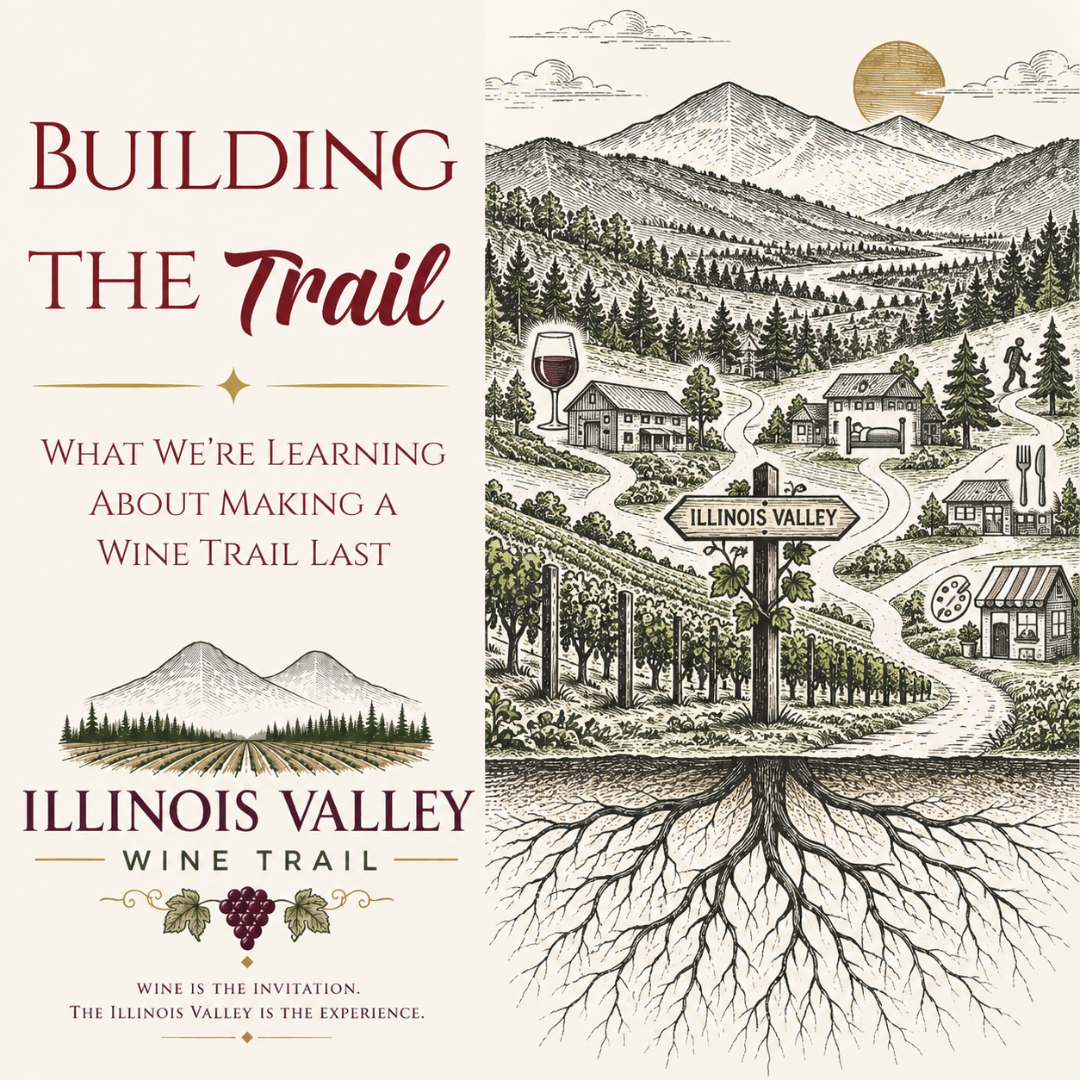
We’re rural. We’re small. Our four wineries are the anchors of the Trail, but the experience visitors encounter here includes much more than wine. It’s lodging, food, outdoor recreation, artists and makers, local businesses, landscapes and communities.
Whatever we build has to work here.
The Part Visitors Don’t See
When visitors experience a wine trail, they see the fun part.
They see a Passport.
A wine tour.
A tasting.
A map.
A beautiful vineyard photograph.
Maybe they discover a restaurant, stay somewhere unexpected or find a business they never would have known existed.
What they don’t see is everything underneath it.
Someone coordinates the wineries. Someone builds partnerships. Someone manages the website, answers emails, designs materials, talks with tourism organizations, organizes events, handles registrations, manages finances, develops sponsorships, creates marketing campaigns and keeps the many moving pieces moving in roughly the same direction.
That work exists whether a wine trail has four wineries or forty.
One of the clearest lessons from our research has been deceptively simple:
The work has to belong somewhere.
And if an organization is going to last, there also has to be a sustainable way to support that work.
Sustainability Doesn’t Come From One Bucket
Another pattern we’re seeing is the importance of diversified revenue.
There doesn’t appear to be one magical funding source that makes a wine trail sustainable.
Instead, established organizations often rely on some combination of membership or winery dues, ticketed events, passports, advertising, sponsorships, business partnerships, tourism support and other earned revenue.
The combination varies.
The principle doesn’t.
Depending too heavily on any single source creates vulnerability. If one event has a bad year, a sponsor leaves, tourism funding changes or member businesses encounter a difficult season, the entire organization shouldn’t wobble with it.
For the Illinois Valley Wine Trail, this has been an important shift in our thinking.
We’re beginning to look less for the revenue model and more at how to build multiple revenue channels that support one another.
That doesn’t mean every idea will work. Part of building something new is testing, measuring and occasionally discovering that an idea looked much prettier on paper.
But it does mean we’re thinking beyond the next event or the next Passport.
We’re thinking about the infrastructure that allows those things to continue.
Governance Matters More Than We Expected
One of the strongest themes emerging from our research has nothing to do with wine.
It’s governance.
When we started asking what helped established wine trails endure, we expected to hear a lot about successful events, tourism marketing and funding.
We did.
But underneath many of those successes was something less visible: a structure for making decisions.
Organizations that last tend to know who is responsible for what. They have mechanisms for member input. They have leadership structures. They establish expectations. They create ways to make decisions even when everyone doesn’t agree.
That matters.
A wine trail brings together independent businesses. Each winery has its own brand, priorities, customers, schedule and financial realities. Add tourism partners, community organizations and regional agencies to the conversation and suddenly there are a lot of voices around the table.
Collaboration doesn’t mean everyone agrees.
Strong governance creates a way to move forward when they don’t.
We’re still exploring what that should ultimately look like for the Illinois Valley Wine Trail. We don’t believe the answer is to import someone else’s bylaws, board structure or organizational chart and change the name at the top.
But we are becoming convinced that governance can’t be an afterthought.
If we’re building for longevity, the structure behind the Trail matters just as much as the experiences people see.
Small Doesn’t Mean Simple
There’s another lesson we keep bumping into.
Being small doesn’t necessarily make this easier.
The Illinois Valley Wine Trail currently connects four wineries. Compared with some of the wine regions we’re studying, that’s tiny.
But small organizations still need marketing. They still need financial systems. They still need partnerships, planning, governance, communication and administration.
They simply have fewer people and fewer dollars available to accomplish those things.
That changes the equation.
It means our model has to be intentionally lean. Partnerships become more important. Regional collaboration becomes more valuable. And every new program has to answer an important question:
Does this create enough value to justify the resources required to sustain it?
That’s a question we’re going to keep asking.
The Illinois Valley Version
Perhaps the most valuable thing we’ve learned so far is that we have permission to build something different.
The Illinois Valley Wine Trail began with wine, and wine will remain at its heart.
But we’re increasingly thinking about the Trail as part of a larger rural tourism ecosystem.
A visitor who comes here for wine may also spend the night in a treehouse or campground, eat at a local restaurant, explore a trail, visit a gallery, buy something from a local maker or discover another corner of the Illinois Valley they didn’t know existed.
That means the value created by a successful wine trail doesn’t stop at the tasting-room door.
And perhaps its support structure shouldn’t either.
We’re exploring what it looks like when wineries, tourism businesses, community partners, events, visitor programs and regional relationships each become part of a broader model.
Not because bigger is automatically better.
Because connected may be stronger.
We’re Still Building
One of the reasons we’re sharing this process publicly is because we don’t want to pretend we already have all the answers.
We don’t.
That’s the point of the research.
We’re talking to people who have been doing this much longer than we have. We’re asking what worked. We’re asking what didn’t. We’re asking who pays for what, who makes decisions, who does the work and what they would do differently if they were starting again today.
Then we’re bringing those lessons home and asking:
What makes sense for the Illinois Valley?
When we started this research, our central question was:
What does it take to build a rural wine trail that lasts?
We’ve realized the answer isn’t one great event, one successful Passport, one funding source or even one particularly good year.
It’s building an organization with enough relationships, revenue streams, governance and shared value that no single piece has to carry the whole thing.
That’s a different kind of trail building.
And we’re only getting started.

No responses yet