September 23, 2026
For the past several months, I’ve been sharing the story of an experiment.
The Illinois Valley Wine Trail began with a fairly straightforward idea: connect our local wineries, create experiences that encourage people to explore the Valley, and see whether a small wine trail could become a useful tourism tool for our community.
But the more research I’ve done, and the more conversations I’ve had with wine trails, destination organizations and rural communities around the country, the bigger the question has become.
What if the real opportunity isn’t simply building a wine trail? What if it’s helping build a more connected visitor experience for the entire Illinois Valley?
Today, that conversation moved into a new phase.
Our First Advisory Council Meeting
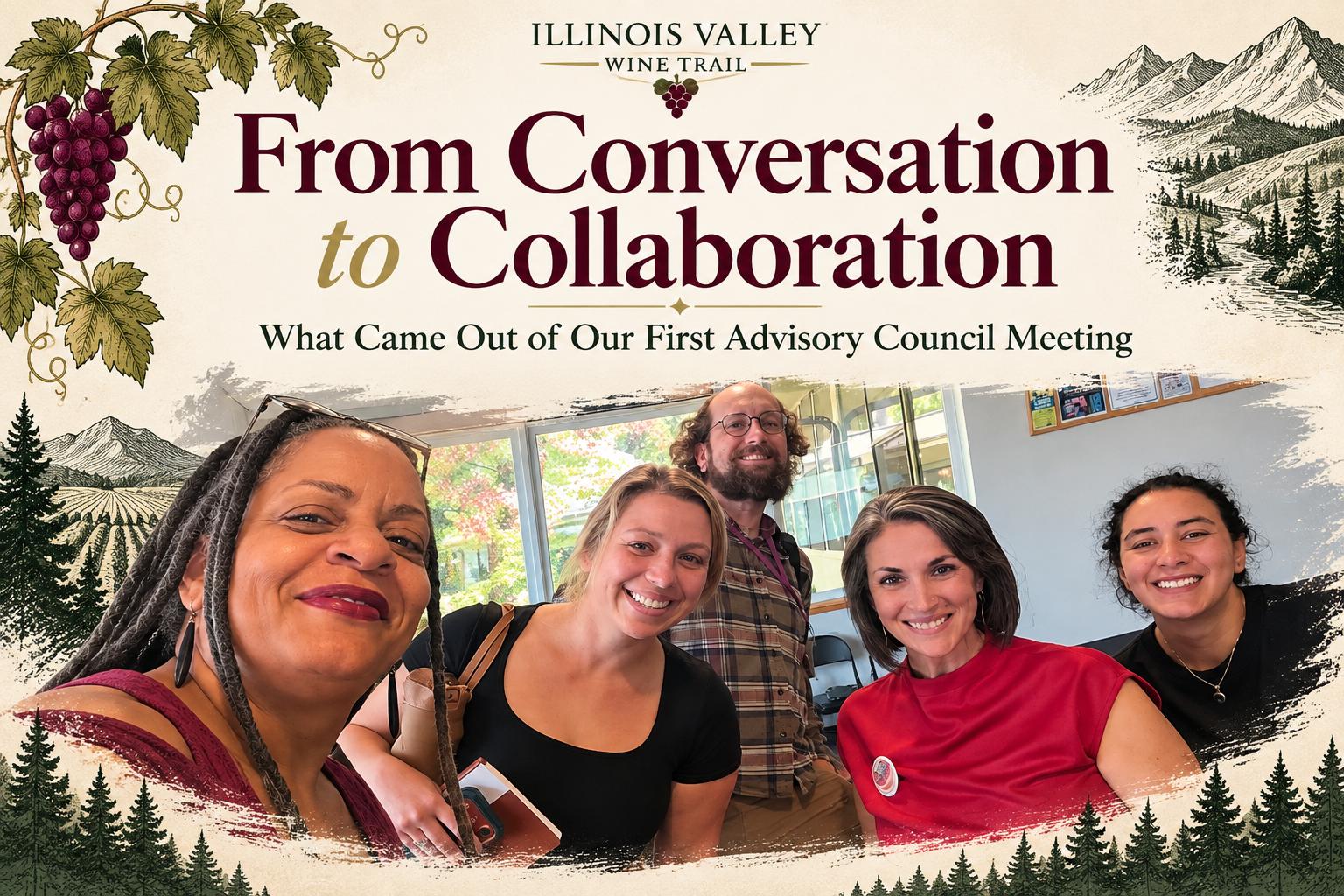
On September 23, the Illinois Valley Wine Trail held its inaugural Advisory Council meeting at the Illinois Valley Branch Library.
The purpose wasn’t to walk into the room with a finished plan and ask people to approve it.
It was to bring together people with different connections to tourism, business, hospitality, recreation, arts, media and community development and ask a much more useful question:
How can we work together to create a stronger, more connected visitor experience throughout the Illinois Valley?
And one theme surfaced again and again.
Before we build something new, let’s connect what we already have.
There is already an enormous amount happening here.
We have wineries and restaurants. We have lodging and campgrounds. We have outdoor recreation, artists, shops, events and community organizations. We have regional partners promoting Southern Oregon. We have websites, calendars, social media pages and people doing good work throughout the Valley.
The challenge isn’t necessarily that nothing exists.
Sometimes, the challenge is that everything exists in different places.
A visitor shouldn’t have to know which organization’s website to search, which Facebook page to follow or which event calendar contains the thing they’re looking for.
That gives us an opportunity to start differently.
Instead of asking first, “What do we need to build?”, we can ask:
“What do we already have, how can we connect it, and where are the real gaps?”
If you’d like to dig into the full discussion, action items and projects that emerged from today’s meeting, you can read the complete September 2026 Advisory Council Meeting Brief & Action Items here.
Read the September 2026 Meeting Brief & Action Items
We Don’t Have to Start With a Hotel
This is an idea I expect to return to often as we continue talking about tourism in the Illinois Valley.
Ask people what the Valley needs to become a stronger destination, and one of the answers you’ll hear again and again is:
We need a hotel.
Maybe someday we do.
But I don’t believe a hotel has to be our starting line.
We can increase lodging capacity incrementally through vacation rentals, farm stays, cabins, RV accommodations, campgrounds and other small-scale lodging experiences that fit the character of the Illinois Valley.
At the same time, we need to work on the other side of the equation.
Why should someone stay overnight?
Can we give a visitor enough to experience that a day trip becomes a weekend? Can we better connect our wineries, outdoor recreation, food, arts, shopping, events and other experiences? Can we encourage people already traveling between Southern Oregon and the coast to spend more time here?
And can we begin tracking what happens when we do?
Growing overnight visitation and demonstrating sustained lodging demand can help us better understand what kinds of additional lodging the Valley may be able to support in the future.
In other words:
We don’t need to wait for a hotel to make us a destination. We need to keep building the kind of destination that can support greater lodging investment.
That philosophy applies to much more than lodging.
Start with the assets we have. Connect them. Identify the gaps. Build what is achievable. Learn from it. Then use what we learn to make the case for the next investment.
Today’s meeting gave us our first opportunity to put that philosophy into practice.
Highway 199 Became Our First Test
Potential extended closures associated with the Highway 199 project beginning in 2027 present a real challenge for the Illinois Valley.
But today’s conversation wasn’t simply about telling travelers, “The highway may be closed.”
The question became:
How do we help people understand what is happening while also showing them what they can do while they’re here?
One idea is a small printed visitor guide connected by QR code to current online information.
The printed piece could introduce travelers to places to eat, shop, explore, stay and experience throughout the Illinois Valley. The digital side could remain flexible enough to connect people with current travel information, itineraries, events and visitor resources.
Distribution could extend beyond the Valley itself, reaching travelers through visitor centers, ranger stations, neighboring communities and other locations along the routes people use to reach us.
And rather than trying to design the entire thing during an Advisory Council meeting, we did something much more useful.
We scheduled a working session.
On Thursday, October 15 at 1:00 PM, we’ll bring together people and organizations interested in helping turn the Highway 199 Visitor Communication Project from an idea into an actual framework.
We’ll work on the guide’s structure and content, the relationship between print and digital resources, distribution, communications, partner roles and immediate assignments.
We’re also expanding the table as the project develops. Today’s discussion highlighted the importance of involving additional stakeholders, including the City of Cave Junction, when their perspective and resources are relevant to the work.
This is exactly what I hoped the Advisory Council could become: not another committee that meets simply because the calendar says it’s time to meet, but a place where ideas can turn into collaborative work.
Other Ideas Started Taking Shape, Too
Highway 199 wasn’t the only opportunity that emerged.
One of our biggest tourism gaps is surprisingly simple:
Photography.
We need more current, high-quality images of the Illinois Valley that organizations and partners actually have permission to use.
There are undoubtedly thousands of beautiful photographs of this Valley sitting on phones, computers and hard drives. The question is how we begin identifying those images, organizing usable assets and eventually creating a shared photography resource that can help all of us tell the Illinois Valley story better.
That work will begin developing before the end of the year.
We also talked about winter and holiday tourism.
Rather than immediately inventing another event, the conversation turned toward connecting and promoting what already exists: holiday light displays, Christmas tree experiences, artisan markets, local events, business specials and other reasons to explore the Valley during a quieter tourism season.
Research into successful holiday and Christmas-light trail models elsewhere in Southern Oregon is already underway.
Again, the principle is the same:
Connect first. Build where there is actually a gap.
The Organizational Question Is Still Open
Another important part of today’s conversation was what we didn’t decide.
We did not create a new tourism organization.
We did not decide that the Illinois Valley Wine Trail should become the umbrella for everything related to tourism.
And we did not decide what the Valley’s long-term tourism structure should look like.
Those conversations are still developing.
The Wine Trail remains an experiment, and I’m continuing to research organizational models used by other wine trails and destination organizations. At the same time, there are already organizations in the Illinois Valley doing economic development, business support, community development and visitor-related work.
So perhaps the most useful question right now isn’t:
Who gets to own tourism?
It’s:
How can we coordinate the work better?
That distinction matters.
You Don’t Need a Seat at the Table to Help Build Something
One thing I want to protect as this work grows is the ability for people to participate without joining another standing committee.
Not everyone needs to attend every Advisory Council meeting.
Someone may have exactly the distribution connection we need for the Highway 199 project.
A photographer may want to contribute images but have no interest in tourism governance.
A business owner may know about a holiday experience we should promote.
A lodging operator may have insight into what visitors ask for when they arrive.
A regional organization may already have a resource we don’t need to recreate ourselves.
That is participation, too.
The Advisory Council can help identify needs, make connections and surface ideas. Smaller working groups can then bring together the people best suited to move individual projects forward.
So, What Happens Next?
The first answer is October 15.
We’ll begin turning the Highway 199 Visitor Communication Project into something tangible.
Before the end of the year, we’ll begin developing the Illinois Valley photography resource.
We’ll continue researching winter and holiday opportunities.
We’ll keep talking with existing organizations and regional partners about how visitor-focused work can be better connected.
And in January, the Advisory Council is anticipated to come together again to look at what we learned, what moved forward and what deserves attention next.
Today wasn’t about unveiling a grand tourism plan for the Illinois Valley.
It was about putting people in a room, asking a big question, discovering where our work overlaps and choosing a real challenge to tackle together.
That may be exactly how we should approach tourism development here, too.
We don’t have to start with the biggest thing.
We can start with what we have.
Connect it. Strengthen it. Learn from it. Build from there.
And then see just how far the Illinois Valley can go.
Wine is the invitation. The Illinois Valley is the experience.

No responses yet